IBFT Consensus Overview
Introduction
Istanbul Byzantine Fault Tolerant (IBFT) consensus is inspired by Castro-Liskov 99 paper. IBFT inherits from the original PBFT by using a 3-phase consensus, PRE-PREPARE, PREPARE and COMMIT. The system can tolerate at most F faulty nodes in a N validator network, where N = 3F + 1.
Implementation
Terminology
Validator: Block validation participant.Proposer: A block validation participant that is chosen to propose block in a consensus round.Round: Consensus round. A round starts with the proposer creating a block proposal and ends with a block commitment or round change.Proposal: New block generation proposal which is undergoing consensus processing.Sequence: Sequence number of a proposal. A sequence number should be greater than all previous sequence numbers. Currently each proposed block height is its associated sequence number.Backlog: The storage to keep future consensus messages.Round state: Consensus messages of a specific sequence and round, including pre-prepare message, prepare message, and commit message.Consensus proof: The commitment signatures of a block that can prove the block has gone through the consensus process.Snapshot: The validator voting state from last epoch.
Consensus
Istanbul BFT Consensus protocol begins at Round 0 with the validators picking a proposer from themselves in a round robin fashion. The proposer will then propose a new block proposal and broadcast it along with the PRE-PREPARE message. Upon receiving the PRE-PREPARE message from the proposer, other validators validate the incoming proposal and enter the state of PRE-PREPARED and broadcast PREPARE message. This step is to make sure all validators are working on the same sequence and on the same round. When ceil(2N/3) of PREPARE messages is received by the validator from other validators, the validator switches to the state of PREPARED and broadcasts COMMIT message. This step is to inform other validators that it accepts the proposed block and is going to insert the block to the chain. Lastly, validators wait for ceil(2N/3) of COMMIT messages to enter COMMITTED state and then append the block to the chain.
Blocks in Istanbul BFT protocol are final, which means that there are no forks and any valid block must be somewhere in the main chain. To prevent a faulty node from generating a totally different chain from the main chain, each validator appends ceil(2N/3) of received COMMIT signatures to extraData field in the header before inserting it into the chain. Thus all blocks are self-verifiable. However, the dynamic extraData would cause an issue on block hash calculation. Since the same block from different validators can have different set of COMMIT signatures, the same block can have different block hashes as well. To solve this, we calculate the block hash by excluding the COMMIT signatures part. Therefore, we can still keep the block/block hash consistency as well as put the consensus proof in the block header.
Consensus States
Istanbul BFT is a state machine replication algorithm. Each validator maintains a state machine replica in order to reach block consensus. Various states in IBFT consensus are,
NEW ROUND: Proposer to send new block proposal. Validators wait forPRE-PREPAREmessage.PRE-PREPARED: A validator has receivedPRE-PREPAREmessage and broadcastsPREPAREmessage. Then it waits forceil(2N/3)ofPREPAREorCOMMITmessages.PREPARED: A validator has receivedceil(2N/3)ofPREPAREmessages and broadcastsCOMMITmessages. Then it waits forceil(2N/3)ofCOMMITmessages.COMMITTED: A validator has receivedceil(2N/3)ofCOMMITmessages and is able to insert the proposed block into the blockchain.FINAL COMMITTED: A new block is successfully inserted into the blockchain and the validator is ready for the next round.ROUND CHANGE: A validator is waiting forceil(2N/3)ofROUND CHANGEmessages on the same proposed round number.
State Transitions:
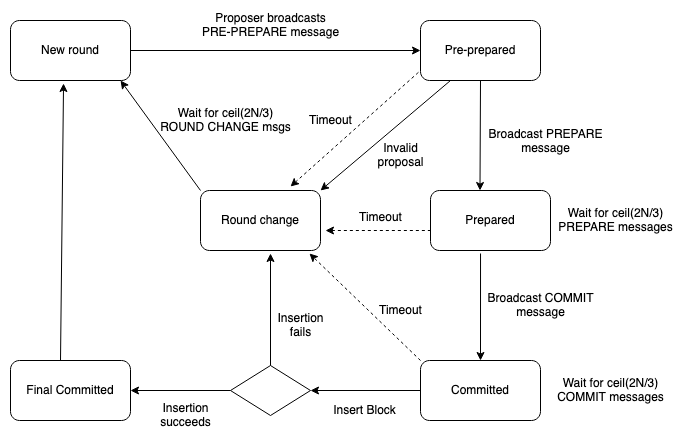
NEW ROUND->PRE-PREPARED:- Proposer collects transactions from txpool.
- Proposer generates a block proposal and broadcasts it to validators. It then enters the
PRE-PREPAREDstate. - Each validator enters
PRE-PREPAREDupon receiving thePRE-PREPAREmessage with the following conditions:- Block proposal is from the valid proposer.
- Block header is valid.
- Block proposal’s sequence and round match the validator‘s state.
- Validator broadcasts
PREPAREmessage to other validators.
PRE-PREPARED->PREPARED:- Validator receives
ceil(2N/3)of validPREPAREmessages to enterPREPAREDstate. Valid messages conform to the following conditions:- Matched sequence and round.
- Matched block hash.
- Messages are from known validators.
- Validator broadcasts
COMMITmessage upon enteringPREPAREDstate.
- Validator receives
PREPARED->COMMITTED:- Validator receives
ceil(2N/3)of validCOMMITmessages to enterCOMMITTEDstate. Valid messages conform to the following conditions:- Matched sequence and round.
- Matched block hash.
- Messages are from known validators.
- Validator receives
COMMITTED->FINAL COMMITTED:- Validator appends
ceil(2N/3)commitment signatures toextraDataand tries to insert the block into the blockchain. - Validator enters
FINAL COMMITTEDstate when insertion succeeds.
- Validator appends
FINAL COMMITTED->NEW ROUND:- Validators pick a new proposer and begin a new round timer.
Round change flow
- There are three conditions that would trigger
ROUND CHANGE:- Round change timer expires.
- Invalid
PREPREPAREmessage. - Block insertion fails.
- When a validator notices that one of the above conditions applies, it broadcasts a
ROUND CHANGEmessage along with the proposed round number and waits forROUND CHANGEmessages from other validators. The proposed round number is selected based on following condition:- If the validator has received
ROUND CHANGEmessages from its peers, it picks the largest round number which hasF + 1ofROUND CHANGEmessages. - Otherwise, it picks
1 + current round numberas the proposed round number.
- If the validator has received
- Whenever a validator receives
F + 1ofROUND CHANGEmessages on the same proposed round number, it compares the received one with its own. If the received is larger, the validator broadcastsROUND CHANGEmessage again with the received number. - Upon receiving
ceil(2N/3)ofROUND CHANGEmessages on the same proposed round number, the validator exits the round change loop, calculates the new proposer, and then entersNEW ROUNDstate. - Another condition that a validator jumps out of round change loop is when it receives verified block(s) through peer synchronization.
Proposer selection
Currently we support two policies: round robin and sticky proposer.
- Round robin: Round robin is the default proposer selection policy. In this setting proposer will change in every block and round change.
- Sticky proposer: in a sticky proposer setting, proposer will change only when a round change happens.
Validator list voting
Istanbul BFT uses a similar validator voting mechanism as Clique and copies most of the content from Clique EIP. Every epoch transaction resets the validator voting, meaning any pending votes for adding/removing a validator are reset.
For all transactions blocks:
- Proposer can cast one vote to propose a change to the validators list.
- Only the latest proposal per target beneficiary is kept from a single validator.
- Votes are tallied live as the chain progresses (concurrent proposals allowed).
- Proposals reaching majority consensus
VALIDATOR_LIMITcome into effect immediately. - Invalid proposals are not to be penalized for client implementation simplicity.
- A proposal coming into effect entails discarding all pending votes for that proposal (both for and against) and starts with a clean slate.
Future message and backlog
In an asynchronous network environment, one may receive future messages which cannot be processed in the current state. For example, a validator can receive COMMIT messages on NEW ROUND. We call this kind of message a “future message.” When a validator receives a future message, it will put the message into its backlog and try to process later whenever possible.
Constants
Istanbul BFT define the following constants
EPOCH_LENGTH: Default: 30000 blocks. Number of blocks after which to checkpoint and reset the pending votes.REQUEST_TIMEOUT: Timeout for each consensus round before firing a round change in millisecond.BLOCK_PERIOD: Minimum timestamp difference in seconds between two consecutive blocks.PROPOSER_POLICY: Proposer selection policy, defaults to round robin.ISTANBUL_DIGEST: Fixed magic number0x63746963616c2062797a616e74696e65206661756c7420746f6c6572616e6365ofmixDigestin block header for Istanbul block identification.DEFAULT_DIFFICULTY: Default block difficulty, which is set to0x0000000000000001.EXTRA_VANITY: Fixed number of extra-data prefix bytes reserved for proposer vanity.- Suggested
32bytes to retain the current extra-data allowance and/or use.
- Suggested
NONCE_AUTH: Magic nonce number0xffffffffffffffffto vote on adding a validator.NONCE_DROP: Magic nonce number0x0000000000000000to vote on removing a validator.UNCLE_HASH: AlwaysKeccak256(RLP([]))as uncles are meaningless outside of PoW.PREPREPARE_MSG_CODE: Fixed number0. Message code forPREPREPAREmessage.PREPARE_MSG_CODE: Fixed number1. Message code forPREPAREmessage.COMMIT_MSG_CODE: Fixed number2. Message code forCOMMITmessage.ROUND_CHANGE_MSG_CODE: Fixed number3. Message code forROUND CHANGEmessageVALIDATOR_LIMIT: Number of validators to pass an authorization or de-authorization proposal.- Must be
floor(N / 2) + 1to enforce majority consensus on a chain.
- Must be
Block Header
Istanbul BFT does not add new block header fields. Instead, it follows Clique in repurposing the ethash header fields as follows:
nonce: Proposer proposal regarding the account defined by the beneficiary field.- Should be
NONCE_DROPto propose deauthorizing beneficiary as an existing validator. - Should be
NONCE_AUTHto propose authorizing beneficiary as a new validator. - Must be filled with zeroes,
NONCE_DROPorNONCE_AUTH
- Should be
mixHash: Fixed magic number0x63746963616c2062797a616e74696e65206661756c7420746f6c6572616e6365for Istanbul block identification.ommersHash: Must beUNCLE_HASHas uncles are meaningless outside of PoW.timestamp: Must be at least the parent timestamp +BLOCK_PERIODdifficulty: Must be filled with0x0000000000000001.-
extraData: Combined field for signer vanity and RLP encoded Istanbul extra data, where Istanbul extra data contains validator list, proposer seal, and commit seals. Istanbul extra data is defined as follows:Thus thetype IstanbulExtra struct { Validators []common.Address //Validator addresses Seal []byte //Proposer seal 65 bytes CommittedSeal [][]byte //Committed seal, 65 * len(Validators) bytes }extraDatawould be in the form ofEXTRA_VANITY | ISTANBUL_EXTRAwhere|represents a fixed index to separate vanity and Istanbul extra data (not an actual character for separator).- First
EXTRA_VANITYbytes (fixed) may contain arbitrary proposer vanity data. ISTANBUL_EXTRAbytes are the RLP encoded Istanbul extra data calculated fromRLP(IstanbulExtra), whereRLP()is RLP encoding function, andIstanbulExtrais the Istanbul extra data.Validators: The list of validators, which must be sorted in ascending order.Seal: The proposer’s signature sealing of the header.CommittedSeal: The list of commitment signature seals as consensus proof.
- First
Block hash, proposer seal and committed seals
The Istanbul block hash calculation is different from the ethash block hash calculation due to the following reasons:
- The proposer needs to put proposer’s seal in
extraDatato prove the block is signed by the chosen proposer. - The validators need to put
ceil(2N/3)of committed seals as consensus proof inextraDatato prove the block has gone through consensus.
The calculation is still similar to the ethash block hash calculation, with the exception that we need to deal with extraData. We calculate the fields as follows:
Proposer seal calculation
By the time of proposer seal calculation, the committed seals are still unknown, so we calculate the seal with those unknowns empty. The calculation is as follows:
Proposer seal:SignECDSA(Keccak256(RLP(Header)), PrivateKey)PrivateKey: Proposer’s private key.Header: Same asethashheader only with a differentextraData.extraData:vanity | RLP(IstanbulExtra), where in theIstanbulExtra,CommittedSealandSealare empty arrays.
Block hash calculation
While calculating block hash, we need to exclude committed seals since that data is dynamic between different validators. Therefore, we make CommittedSeal an empty array while calculating the hash. The calculation is:
Header: Same asethashheader only with a differentextraData.extraData:vanity | RLP(IstanbulExtra), where in theIstanbulExtra,CommittedSealis an empty array.
Consensus proof
Before inserting a block into the blockchain, each validator needs to collect ceil(2N/3) of committed seals from other validators to compose a consensus proof. Once it receives enough committed seals, it will fill the CommittedSeal in IstanbulExtra, recalculate the extraData, and then insert the block into the blockchain. Note that since committed seals can differ by different sources, we exclude that part while calculating the block hash as in the previous section.
Committed seal calculation:
Committed seal is calculated by each of the validators signing the hash along with COMMIT_MSG_CODE message code of its private key. The calculation is as follows:
Committed seal:SignECDSA(Keccak256(CONCAT(Hash, COMMIT_MSG_CODE)), PrivateKey).CONCAT(Hash, COMMIT_MSG_CODE): Concatenate block hash andCOMMIT_MSG_CODEbytes.PrivateKey: Signing validator’s private key.
Provenance
Istanbul BFT implementation in Quorum is based on EIP 650. It has been updated since the EIP was opened to resolve safety issues by introducing locking.